


Every organisation wants to grow margins, yet few have the tools and structure to do it consistently. Once a pricing engine is up and running, your business can finally move beyond spreadsheet chaos, manual guesswork, and reactive pricing. But what really causes an increase in profit margin once a price engine for profits is implemented?
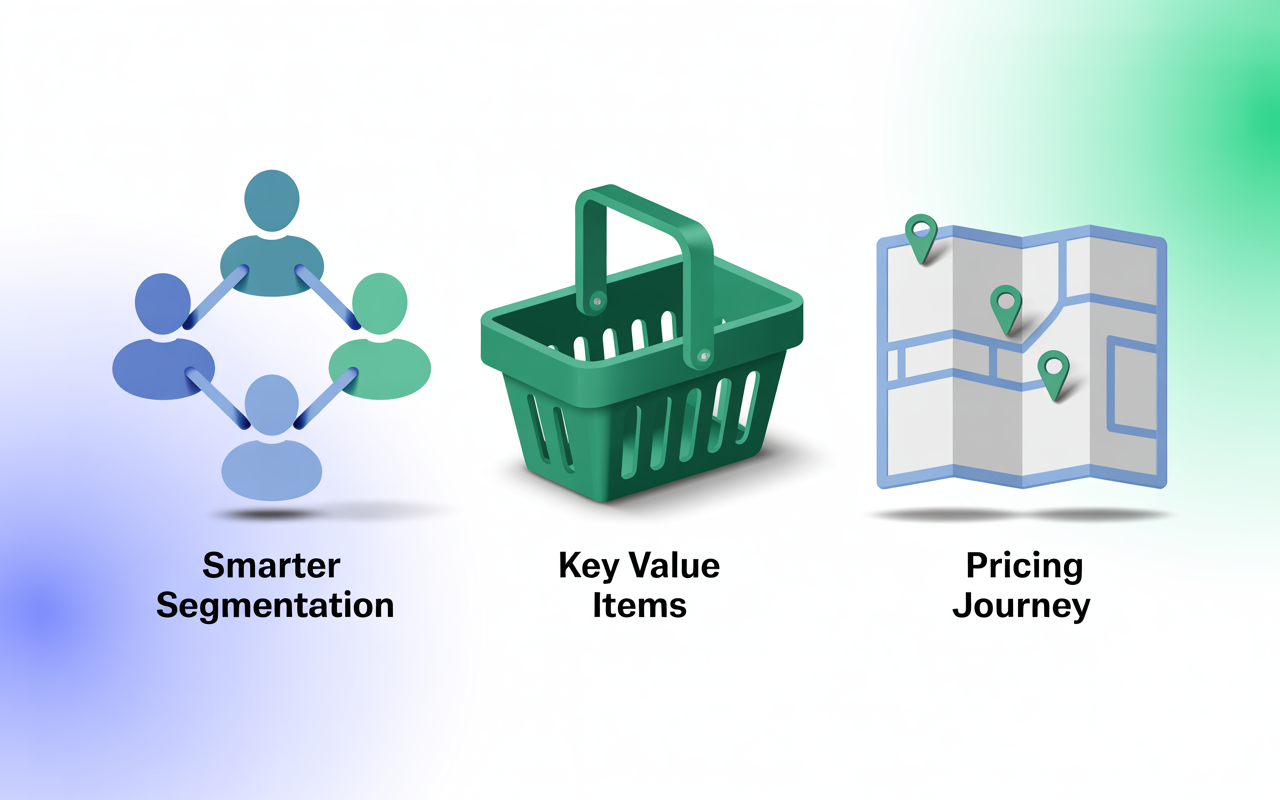
Below, we explore three core concepts you can apply immediately to unlock uplift, improve control, and accelerate margin growth. These concepts show exactly how to increase operating profit margin in a scalable and sustainable way.
If you are evaluating a price engine for profit growth, these are the strategies that will create measurable ROI.
Concept 1: Smarter Segmentation: Customers, Channels, and Products
Before you can optimise prices, you must first understand who you are pricing for and what you are pricing. This is where segmentation becomes the foundation of every successful pricing engine strategy.
Once your data is organised into meaningful groups, the engine can begin applying differentiated price rules that reflect value, behaviour, and market dynamics. In other words, segmentation is the starting point that allows a price engine for profit growth to actually deliver results.
Customer Segmentation (B2B)
In B2B markets, margin performance varies widely across customer groups. But in Excel, managing all these dimensions – demographics, geography, behavioural buying patterns, and psychological aspects – quickly becomes unmanageable.
A pricing engine allows you to segment customers with precision and assign pricing rules that match their value, willingness to pay, and purchasing behaviour.
This creates consistent, logical price differentiation and helps you capture the true value of your products.
This is one of the most effective price engine for profit growth strategies because segmentation naturally unlocks hidden margin reserves.
Channel Segmentation (B2C & Marketplaces)
In B2C environments, pricing differs not by account but by sales channel. Whether you sell on Bol.com, Coolblue, Google Shopping, Amazon, Otto, or Kaufland, each channel behaves differently.
A pricing engine gives you the flexibility to:
- Set channel-specific price rules
- Respond to marketplace competition
- Optimise for conversion or margin per channel
The result: you stop leaving money on the table by applying one universal price everywhere.
Product Segmentation
Just as customers differ, products require segmentation too. A pricing engine helps classify your catalogue into:
- Commodity vs non-commodity
- Fast movers vs slow movers
- New or unfamiliar products entering the market
For each segment, different pricing tactics apply:
- Commodity slow movers: rely on competitive pricing and sensitivity models
- Commodity fast movers: combine competitive data with elasticity and A/B testing
- Non-commodity slow movers: use price sensitivity modelling where data is limited
- Non-commodity fast movers: use elasticity and transactional data to optimise
By applying the right optimisation per product type, the organisation quickly learns what causes an increase in profit margin across the catalogue.
Concept 2: Key Value Items and Basket-Based Margin Expansion
Key value items (KVIs) are products that drive traffic, sales volume, or basket entry. Customers often judge your entire pricing strategy based on these items. Once the pricing engine tracks all transactions and basket patterns, you can identify these KVIs and price them sharply to stay competitive.
The real margin expansion happens with the substitute products purchased alongside them. While you might price KVIs aggressively, the engine helps you increase margins on complementary items to compensate.
This is a proven price engine for a profit strategy because it increases:
- Share of wallet
- Average order value
- Total margin per basket
KVIs differ per customer group or per channel, which is why automation is essential. A manual approach simply cannot maintain this complexity at scale.
Concept 3: Advancing Through the Price Maturity Journey
A price engine does more than optimise single prices; it elevates your entire operating model. Most organisations start at Pricing 1.0, where the focus is purely on volume. With a price engine, you move through higher maturity phases that fundamentally improve how to increase operating profit margin:
1. Volume-Driven Pricing: Focus on selling more units with minimal margin control.
2. Transactional Control: You start analysing price execution per customer, per channel, per product. You understand what works, what leaks margin, and where inconsistencies appear.
3. Full Value Capture: Pricing becomes a repeatable process, not an occasional project. You apply rules, governance, and methodologies to capture value consistently.
4. Algorithmic Pricing: The engine learns from every cycle: pulling in competitive data, market signals, elasticity, and demand patterns, and continuously reprices your assortment based on real behaviour.
At this stage, you truly unlock the power of a pricing engine, because the organisation can process far more data than any team could manually. This is where companies see the strongest shift in profit, answering the key question of what causes an increase in profit margin across the business.
Why a Price Engine Is Essential for Profit Growth
A modern pricing engine does more than automate calculations. It helps your organisation:
- Understand the true value of each customer
- Tailor prices per market, channel, or marketplace
- Optimise product categories differently
- Automate pricing complexity at scale
- Continuously learn and improve based on market behaviour
When implemented correctly, the outcome is clear: you capture value you were previously missing, and you see exactly how to increase operating profit margin month after month. This is the core reason more companies are investing in a price engine for profit growth, because it modernises pricing, reduces manual errors, and generates measurable returns.
These three concepts: segmentation, key value item strategy, and advancing up the price maturity curve, represent the fastest and most reliable ways to increase margins with a pricing engine.
Whether you want to understand what causes an increase in profit margin or how to execute smarter, scalable pricing decisions, these strategies form the foundation. Once applied, your organisation gains the clarity, automation, and intelligence required to drive sustainable profit growth.
If you're exploring a price engine for profits, these approaches will ensure your investment translates into tangible margin improvement.
Do you want a free demo to try how SYMSON can help your business with margin improvement or pricing management? Do you want to learn more? Schedule a call with a consultant and book a 20 minute brainstorm session!



.png)

.png)


